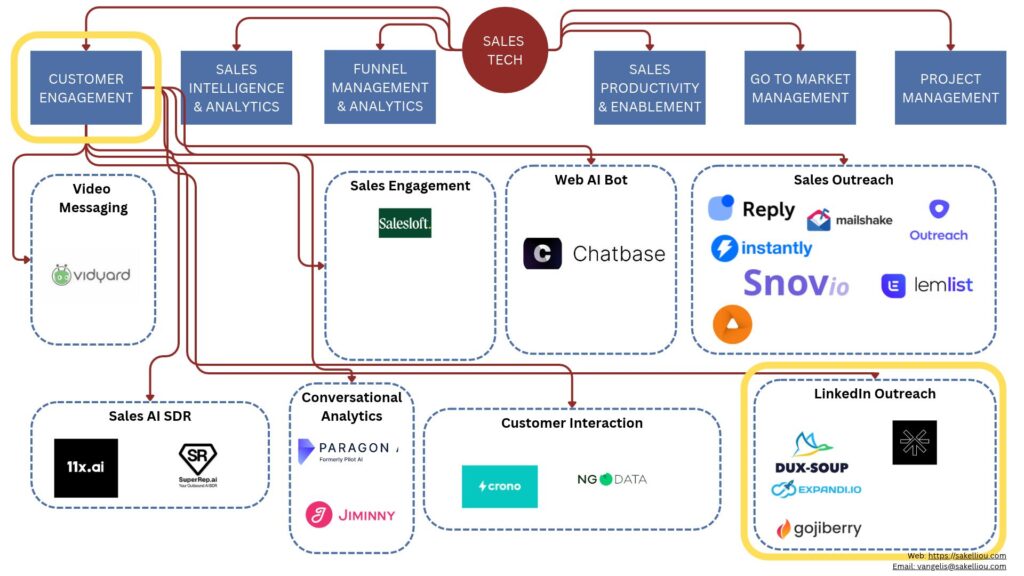
Understanding the Framework
Hi, I am Vangelis and you are reading this article which is part of The State of the Growth Stack — a series that explores the technologies shaping modern sales and marketing.
Each article focuses on one category within the stack, helping founders, sales leaders, and GTM teams understand what the technology does, where it fits, and how it contributes to growth.
We continue exploring Customer Engagement, one of the main categories within the Sales Technology Stack.
In the previous edition, we looked at Sales Outreach, examining how technology helps sales teams manage prospecting, automate follow-ups, and coordinate communication across different channels.
Today, we move to a more specific area: LinkedIn Outreach.
LinkedIn has become an important channel for B2B sales, particularly when organisations want to reach senior decision-makers, enter new markets, or develop relationships with potential customers.
But there is a significant difference between using LinkedIn to build business relationships and simply sending hundreds of connection requests.
This is where LinkedIn outreach technology comes into the picture.
Are We Connecting With People or Just Collecting Connections?
One thing that always surprises me is how many salespeople measure their LinkedIn success by the number of connections they have.
They proudly tell you they have 10,000 or 20,000 connections.
My question is always the same.
How many of those connections have turned into meaningful business conversations?
Having thousands of connections doesn’t necessarily mean you have a strong professional network. And having a strong network doesn’t automatically mean you are generating business opportunities.
I often see organisations treating LinkedIn as another cold outreach channel.
They identify hundreds of prospects, send connection requests, and immediately follow up with a sales pitch.
Sometimes the message is so generic that you wonder whether the sender has even looked at your profile.
The result?
Low engagement, ignored messages, and potentially damaged relationships before they have even started.
The problem isn’t LinkedIn.
The problem is how companies approach LinkedIn prospecting.
LinkedIn outreach should be about identifying the right people, starting relevant conversations, and gradually developing business relationships.
Technology can help organisations do this more efficiently. But it cannot compensate for poor targeting, irrelevant messaging, or a weak sales proposition.
And that is something worth remembering before investing in another tool.
3 Key Takeaways
1. Better targeting matters more than more connections.
The objective isn’t to grow your LinkedIn network as quickly as possible. It is to connect with people who match your ideal customer profile and have a genuine reason to engage with your business.
2. Automation should support relationships, not replace them.
LinkedIn outreach tools can reduce repetitive work, organise prospecting activities, and help manage follow-ups. But meaningful conversations still require human judgement and personal attention.
3. Measure business opportunities, not LinkedIn activity.
Connection acceptance rates and replies are useful indicators. However, the real measure of success is whether those conversations generate qualified meetings, sales opportunities, and eventually revenue.
If you’re looking to grow your sales and build stronger client relationships, take a look at how I help teams like yours — and feel free to reach out for a chat.
All my books are on Amazon HERE
Why LinkedIn Outreach Matters
B2B Buyers Are Difficult to Reach
Think about how B2B sales prospecting has changed.
Years ago, salespeople relied heavily on telephone calls, industry directories, conferences, and personal introductions.
Email became another important channel, allowing organisations to contact thousands of potential customers relatively easily.
But as more companies adopted email outreach, inboxes became increasingly crowded.
Decision-makers receive messages from salespeople every day. Many are ignored, filtered, or deleted without being read.
LinkedIn offers another way to approach these people.
It allows salespeople to identify professionals based on their roles, organisations, industries, and professional backgrounds.
More importantly, it provides information that can help make an approach relevant.
For example, imagine you are selling a sales performance solution to financial institutions.
Instead of sending emails to a generic list of financial services executives, you could identify Heads of Sales, Commercial Directors, or Revenue Operations leaders within a specific group of institutions.
You can examine their responsibilities, recent professional activity, and company developments before approaching them.
This doesn’t guarantee a response.
But it gives you a better starting point.
The Problem With Manual LinkedIn Prospecting
The challenge appears when organisations want to make LinkedIn a consistent part of their business development activities.
Consider a salesperson who needs to:
- Identify relevant companies.
- Find the right decision-makers.
- Review their profiles.
- Send connection requests.
- Track who accepted.
- Follow up with appropriate messages.
- Record conversations in the CRM.
- Identify opportunities requiring further attention.
Each activity takes time.
For someone managing a small number of strategic accounts, doing everything manually may be perfectly reasonable.
But for an SDR managing hundreds of prospects across several campaigns, it becomes difficult to maintain consistency.
Some prospects receive follow-ups. Others are forgotten.
Some conversations are recorded in the CRM. Others remain buried in LinkedIn messages.
And sales managers often struggle to understand whether LinkedIn is contributing to pipeline generation.
This is the operational problem LinkedIn outreach tools attempt to solve.
They help organise prospecting activities, manage sequences, and track engagement so salespeople can spend more time on conversations that matter.
LinkedIn Is Not Just Another Messaging Channel
There is another important distinction.
Email outreach usually begins with a message arriving in someone’s inbox.
LinkedIn offers several ways to develop familiarity before starting a direct conversation.
A salesperson might comment on a prospect’s post, share relevant industry information, engage with a company announcement, or connect through a mutual professional interest.
These activities can make the eventual approach more natural.
I believe this is where many organisations miss an opportunity.
They use LinkedIn as if it were simply another email platform.
But LinkedIn is also a professional network.
And the value of a professional network comes from relationships, not message volume.
What LinkedIn Outreach Technology Actually Does
LinkedIn outreach platforms are designed to help sales teams manage prospecting and communication activities on LinkedIn.
They typically work alongside LinkedIn itself, LinkedIn Sales Navigator, and other sales technologies.
Depending on the solution, they provide several capabilities.
1. Prospect Identification and Targeting
Before contacting anyone, sales teams need to identify the right audience.
LinkedIn outreach tools can help organise prospect lists created through LinkedIn searches or Sales Navigator.
These lists may be based on:
- Industry and company size.
- Job title and seniority.
- Geography.
- Target accounts.
- Professional characteristics relevant to the campaign.
Why does this matter?
Because better targeting reduces wasted sales activity.
For example, a company entering the German market might want to approach Commercial Directors at manufacturing companies with more than 200 employees.
Rather than contacting anyone with a senior title, the sales team can concentrate on a defined audience.
However, the quality of the targeting still depends on how well the organisation understands its ideal customer profile.
Technology makes prospecting easier. It doesn’t decide which customers are right for your business.
2. Connection Request Management
One of the most time-consuming parts of LinkedIn prospecting is managing connection requests.
Salespeople need to identify prospects, send invitations, and monitor who accepts.
Some outreach tools can automate or organise parts of this process.
For example, a salesperson might prepare a list of 100 relevant prospects and create a campaign to approach them over time.
The tool can help track which invitations have been sent and which prospects have accepted.
This reduces administrative work and provides a clearer view of campaign progress.
But there is an important consideration.
Sending more connection requests doesn’t necessarily mean creating more business opportunities.
LinkedIn has platform rules and restrictions concerning automated activity. Third-party automation can put accounts at risk, including restrictions or suspension.
Organisations should therefore assess compliance and account safety before using automation, rather than assuming that a tool’s availability makes every automated action acceptable.
3. Personalised Messaging and Follow-Ups
Once a connection has been established, the next challenge is starting a conversation.
Many LinkedIn outreach platforms allow users to create message sequences using information from prospect profiles.
For example, messages might include a person’s name, company, or role.
Some tools also support conditional follow-ups based on whether a prospect has responded.
This can save time, particularly when sales teams are approaching similar buyer profiles.
However, there is a difference between personalisation and relevance.
Including someone’s first name and company in a message doesn’t make it relevant.
A relevant message demonstrates that you understand something about the recipient’s responsibilities, challenges, or business situation.
For example:
A generic message might say:
“Hi John, I help companies improve sales performance. Would you like to schedule a meeting?”
A more relevant approach could be:
“Hi John, I noticed you’re responsible for a sales organisation operating across several European markets. I’m interested in how companies manage sales performance consistently across different countries.”
The second message gives the recipient a reason to engage.
The technology can help deliver and organise messages.
The salesperson still needs to understand what makes the conversation worth having.
4. Outreach Sequences and Campaign Management
Sales prospecting rarely succeeds through one interaction.
A prospect might accept a connection request but not respond immediately.
Another might respond after seeing a relevant post.
Someone else might express interest but ask to reconnect in a few months.
LinkedIn outreach platforms help sales teams organise these interactions into campaigns.
A typical process might involve:
- Identifying a targeted group of prospects.
- Reviewing their profiles and business relevance.
- Sending connection requests.
- Starting a conversation when appropriate.
- Following up with relevant information.
- Moving interested prospects into the sales process.
The advantage is consistency.
Salespeople can manage several prospecting campaigns without relying entirely on spreadsheets, reminders, or memory.
However, I would be careful about creating long sequences of automated messages.
A prospect who doesn’t respond after several approaches may simply not be interested.
Knowing when to stop is as important as knowing when to follow up.
5. Combining LinkedIn With Other Sales Channels
LinkedIn outreach becomes more valuable when it is connected to the broader sales process.
Imagine a salesperson targeting a specific company.
They might first identify the relevant decision-makers through Sales Navigator.
They could then engage with professional content, establish a connection, and eventually follow up through email or a telephone call where appropriate.
Different channels support different stages of the relationship.
Some LinkedIn outreach platforms also support multichannel campaigns, particularly combinations of LinkedIn and email.
This helps sales teams coordinate their activities rather than treating each channel independently.
But the objective shouldn’t be to contact the same person everywhere simply because the technology allows it.
The objective is to choose the most appropriate channel for each interaction.
6. Measuring Engagement and Sales Results
One of the advantages of using dedicated outreach technology is the ability to measure activities more consistently.
Sales teams can monitor indicators such as:
- Connection acceptance rates.
- Message response rates.
- Positive responses.
- Qualified conversations.
- Meetings booked.
- Opportunities created.
Some platforms also provide campaign-level reporting.
This helps sales leaders identify which audiences, messages, and approaches are producing better results.
But I would go one step further.
LinkedIn campaign performance should eventually connect to CRM data.
Otherwise, you might know that a campaign generated 40 replies but have no idea whether those replies produced valuable opportunities.
For a commercial leader, that is a significant gap.
The Evolution of LinkedIn Outreach
LinkedIn prospecting has evolved considerably.
In its early days, LinkedIn was primarily used to establish professional connections, maintain relationships, and research people or organisations.
Salespeople used it to identify decision-makers and learn more about prospective customers.
As the platform grew, companies began using it more actively for lead generation.
Sales Navigator made targeted prospect research more practical, while third-party tools introduced ways to organise and automate outreach activities.
The next development was campaign automation.
Instead of managing every connection request and message manually, salespeople could create prospect lists and communication sequences.
This increased the number of people they could approach.
But it also created another problem.
Automation made it easier to send messages. It didn’t necessarily make those messages better.
As more sales teams adopted similar approaches, LinkedIn users began receiving repetitive connection requests and generic pitches.
Now AI is introducing another change.
AI can help salespeople research prospects, prepare messages, identify relevant company information, and suggest follow-ups.
That can improve productivity.
But it also makes it easier to produce large volumes of messages that look personalised without demonstrating any genuine understanding of the recipient.
I expect the difference between good and poor LinkedIn outreach to become even more noticeable.
The organisations that simply increase message volume will struggle to stand out.
Those that combine better targeting, relevant information, and thoughtful engagement will have a stronger foundation for building relationships.
There is also an important question about the future of automation itself.
LinkedIn restricts certain automated activities, and organisations should not build their entire prospecting strategy around practices that could expose their accounts to enforcement action.
For this reason, I see a growing distinction between tools that help salespeople research, organise, and manage their work and tools that automate interactions on their behalf.
That distinction matters when deciding how LinkedIn should fit into a company’s sales strategy.
Tool Spotlight #1: Dux-Soup
What It Is
Dux-Soup is a LinkedIn prospecting and automation platform designed to help salespeople manage activities such as identifying prospects, organising outreach, and following up with connections.
The solution offers browser-based and cloud-based approaches, giving users different ways to manage their LinkedIn prospecting activities.
Why Teams Use It
Dux-Soup is particularly relevant for sales professionals and smaller business development teams that want to introduce more structure into their LinkedIn activities.
For example, a salesperson who regularly identifies prospects through LinkedIn or Sales Navigator might want to organise those prospects into campaigns rather than managing every interaction individually.
The potential benefit is straightforward.
Less time spent on repetitive administration and more consistency in managing prospecting activities.
Practical Example
Imagine a business development consultant targeting founders of B2B technology companies in the UK.
The consultant identifies a group of companies matching a specific customer profile.
Using LinkedIn and supporting prospecting tools, they organise the relevant decision-makers and plan their outreach.
Dux-Soup can help manage elements of that prospecting process, including campaign activity and follow-up tracking.
The consultant can then concentrate on understanding which prospects are responding and where a more personal conversation is required.
My View
I see Dux-Soup as an example of technology that can help individual salespeople and smaller teams become more organised.
Its value isn’t necessarily in increasing the number of messages sent.
It is in reducing repetitive work and helping users maintain a consistent prospecting process.
However, I would encourage organisations to be selective about what they automate.
Research, campaign organisation, and activity tracking are useful areas to improve.
Automating direct interactions requires additional consideration because of LinkedIn’s platform restrictions.
For smaller teams, I would start by improving targeting and campaign discipline before introducing more automation.
Tool Spotlight #2: Expandi
What It Is
Expandi is a cloud-based LinkedIn outreach platform designed for teams managing more structured prospecting campaigns.
Its approach places particular emphasis on outreach sequences, campaign management, personalisation, and combining LinkedIn activities with email outreach.
Why Teams Use It
Expandi is relevant to organisations that want to manage several prospecting campaigns across different audiences or markets.
For example, a B2B company might have separate campaigns targeting:
- CEOs of technology companies.
- Heads of Sales in financial services.
- Commercial Directors in manufacturing.
- Revenue Operations leaders in larger organisations.
Each audience has different priorities.
Therefore, each should receive a different approach.
A platform such as Expandi can help teams organise these campaigns and assess their performance.
Practical Example
Consider a SaaS company expanding into three European markets.
The sales team wants to approach decision-makers in Germany, France, and the Netherlands.
Rather than using one generic campaign, the company develops different messages based on each market and buyer profile.
Expandi can help organise the campaigns, manage sequences, and monitor engagement.
The sales manager can then compare how different audiences respond and identify where the team should concentrate its efforts.
Of course, the real commercial value appears only when the resulting conversations turn into qualified opportunities.
My View
Expandi represents a more campaign-oriented approach to LinkedIn outreach.
I can see its appeal for agencies and sales teams managing several audiences or prospecting initiatives simultaneously.
However, more sophisticated campaign capabilities don’t automatically produce better sales results.
If the targeting is poor, the messaging irrelevant, or the proposition weak, automation simply allows the organisation to repeat those mistakes more efficiently.
I would also assess the operational and account risks before adopting automated LinkedIn messaging.
The most important question isn’t how many campaigns the platform can run. It is whether those campaigns are reaching the right people and generating valuable conversations.
Tool Spotlight #3: Gojiberry
What It Is
Gojiberry is an AI-powered B2B prospecting and outreach platform that focuses on identifying potential customers based on buying intent and professional activity.
Unlike traditional LinkedIn outreach tools that primarily help salespeople manage connection requests and messaging campaigns, Gojiberry takes a different approach.
It identifies prospects showing relevant buying or engagement signals, assesses how closely they match a company’s ideal customer profile (ICP), and helps initiate personalised conversations through LinkedIn and email.
These signals might include someone engaging with a competitor’s content, changing jobs, working for a company that recently raised funding, or showing interest in topics related to your business.
The idea is to approach prospects when there is a relevant reason to contact them, rather than simply working through a static list of leads.
Why Teams Use It
Gojiberry is particularly relevant for B2B sales teams that want to improve prospect targeting and reduce the time spent researching potential customers.
Instead of asking salespeople to manually identify prospects and monitor their activities, the platform helps identify relevant contacts based on predefined criteria and engagement signals.
For example, a company might want to identify:
- Decision-makers engaging with competitors’ LinkedIn content.
- Companies that have recently received funding.
- Senior executives who have recently changed positions.
- Prospects discussing topics related to the company’s products or services.
- Companies showing growth through recruitment activities.
The platform then uses this information to help prepare personalised outreach messages.
For sales teams, the potential benefit is not simply more outreach activity.
It is the ability to concentrate prospecting efforts on people who may have a stronger reason to engage.
Practical Example
Imagine a company selling a sales commission management solution to medium-sized and large organisations.
The sales team wants to approach Heads of Sales, Sales Operations Directors, and HR Compensation Managers.
Rather than building a large list of contacts and sending the same message to everyone, the company uses Gojiberry to identify relevant prospects based on their professional activity and company developments.
For example, the platform might identify a newly appointed Head of Sales at a company that is expanding its commercial team.
This could be a relevant opportunity because a new sales leader may be reviewing existing sales processes, performance management practices, and incentive structures.
Gojiberry can help prepare a personalised LinkedIn message based on that context and manage the subsequent outreach.
The salesperson can then concentrate on prospects who respond positively and develop those conversations into qualified opportunities.
Of course, a job change or company expansion doesn’t automatically mean someone is ready to buy.
But it provides a more relevant starting point than approaching hundreds of contacts without understanding their circumstances.
My View
What I find interesting about Gojiberry is its emphasis on identifying why a prospect might be worth approaching before deciding how to approach them.
This is an important distinction.
Many sales teams concentrate on improving outreach execution. They invest in tools that help them send more messages, create more sequences, and manage more contacts.
But they often overlook the question that should come first.
Why are we approaching this particular person, and why now?
I believe this is where intent-based prospecting can create value.
If a company can identify prospects who match its ICP and demonstrate relevant business signals, it can potentially improve the quality of its outreach.
However, I would be careful about treating every engagement signal as buying intent.
Someone commenting on a competitor’s LinkedIn post doesn’t necessarily mean they are evaluating competing solutions.
A newly appointed executive isn’t automatically looking for new suppliers.
These signals should inform the sales approach, not replace qualification.
I also believe human judgement remains important when deciding which prospects to contact and what message to send. Organisations should assess LinkedIn’s automation restrictions before enabling automated interactions.
For companies already using LinkedIn for business development, Gojiberry represents an interesting shift from volume-based prospecting towards more targeted, signal-based outreach.
And in my experience, improving who you approach and when you approach them is often more valuable than simply increasing the number of messages you send.
Practical Use Cases for LinkedIn Outreach
LinkedIn outreach can support several commercial objectives, depending on the organisation’s business model and sales strategy.
1. Generating New Sales Opportunities
This is probably the most obvious application.
Sales teams identify companies matching their ideal customer profile and approach relevant decision-makers.
For organisations selling B2B products or services, LinkedIn can be particularly useful when the target audience consists of identifiable professional roles.
For example, a cybersecurity company might target CISOs, IT Directors, and Heads of Information Security.
The objective is to start conversations that could eventually develop into qualified sales opportunities.
2. Entering New Markets
When companies expand internationally, they often lack established relationships in their target markets.
LinkedIn can help identify potential customers, local partners, distributors, and other relevant business contacts.
I have seen how important this can be for organisations entering a new country.
Before investing heavily in local sales resources, a company can use targeted prospecting to understand whether its proposition generates interest.
It is also an opportunity to learn about the market.
What problems do prospective customers mention?
Who makes purchasing decisions?
How do organisations currently solve the problem?
These conversations can provide valuable information before a company commits significant resources.
3. Supporting Account-Based Sales
For companies selling to larger organisations, the sales process often involves several stakeholders.
A single connection with one decision-maker is rarely enough.
LinkedIn can help salespeople identify other people involved in the purchasing process.
For example, a company selling a sales compensation platform might need to engage Sales Operations, Finance, HR, and senior commercial management.
A coordinated approach can help the sales team understand the organisation and develop relationships with relevant stakeholders.
This is particularly useful for complex B2B sales.
4. Reconnecting With Existing Contacts
Not every LinkedIn campaign needs to target people you have never met.
Sometimes the best opportunities come from people already in your network.
Former customers, previous prospects, past colleagues, and professional contacts may have moved into new roles or organisations.
LinkedIn makes it easier to identify these changes and reconnect.
In my experience, this is often an overlooked source of business opportunities.
A conversation with someone who already knows you can be considerably more productive than starting from zero.
5. Supporting Customer Relationships and Expansion
LinkedIn can also support existing customer relationships.
Account managers can stay informed about organisational changes, new appointments, company developments, and professional activity.
For example, an existing customer might appoint a new Commercial Director or expand into another market.
These developments could create opportunities for additional services.
The objective isn’t to turn every company announcement into a sales pitch.
It is to stay informed and recognise when a conversation might be useful.
How Should You Measure LinkedIn Outreach Performance?
One of the mistakes I frequently see is organisations measuring LinkedIn activity without connecting it to commercial outcomes.
A campaign might generate hundreds of connections and dozens of replies.
That sounds encouraging.
But what happens next?
I would recommend looking at performance across three levels.
First, targeting and engagement.
Are you approaching the right audience? Are people accepting connection requests? Are they responding?
Second, qualification and pipeline creation.
How many responses lead to meaningful conversations? How many become qualified meetings? How many create sales opportunities?
Third, commercial results.
What is the value of the opportunities created? How many convert into customers? How much revenue can reasonably be attributed to the channel?
Consider two hypothetical campaigns.
Campaign A generates 100 new connections and 30 replies but produces only one qualified opportunity.
Campaign B generates 40 connections and 12 replies but produces five qualified opportunities.
Which campaign would you prefer?
For me, the answer is obvious.
The purpose of LinkedIn outreach isn’t to maximise engagement. It is to generate commercially relevant engagement.
That distinction should influence everything from audience selection to campaign reporting.
My Take
I believe LinkedIn is one of the most useful channels for B2B business development, particularly when selling to senior professionals or entering markets where personal relationships matter.
But I also believe it is one of the most frequently misused.
Too many salespeople approach LinkedIn with the same mentality they use for mass email campaigns.
Find a list.
Send a message.
Follow up several times.
Move to the next list.
And when the results are disappointing, increase the volume.
I don’t think that is the answer.
In my experience, the biggest improvement in outreach performance usually comes from better targeting and more relevant conversations, not simply more activity.
Before investing in LinkedIn outreach technology, I would ask three questions.
Do we know exactly which companies and decision-makers we want to approach?
Do we understand why those people should be interested in speaking with us?
Do we have a clear process for turning a positive response into a qualified sales opportunity?
If the answers are unclear, technology won’t solve the underlying problem.
There is another point worth making.
Not every sales team needs automated LinkedIn outreach.
If you are targeting 30 strategic accounts with high contract values and complex purchasing processes, I would probably favour a more personal approach.
Research the companies properly. Understand their challenges. Identify the relevant stakeholders. Develop relationships.
On the other hand, if you are managing a larger number of potential customers across different segments, technology can help organise prospecting and reduce administrative work.
The right approach depends on your sales model.
I would also distinguish between LinkedIn as a relationship-building channel and LinkedIn as a prospecting channel.
They are connected, but they aren’t identical.
A salesperson who regularly shares useful content, participates in relevant discussions, and develops a credible professional presence may find it easier to start conversations.
That credibility cannot simply be automated.
And as AI makes it easier for everyone to produce messages, I believe genuine professional credibility will become even more valuable.
Finally, there is the question of measurement.
If LinkedIn is an important sales channel, it should be treated as part of the company’s GTM strategy.
That means defining the target audience, allocating resources, testing approaches, measuring conversion, and connecting results to the sales pipeline.
Otherwise, LinkedIn remains an activity rather than a managed source of business opportunities.
Frequently Asked Questions (FAQs)
1. What is the difference between LinkedIn outreach and sales outreach?
LinkedIn outreach focuses specifically on identifying, approaching, and engaging prospects through LinkedIn.
Sales outreach is a broader category covering different communication channels, including email, telephone calls, LinkedIn, and other direct prospecting activities.
LinkedIn outreach can therefore be one component of a wider sales outreach strategy.
For many B2B organisations, combining several appropriate channels is more effective than relying exclusively on one.
2. Is LinkedIn outreach automation safe to use?
Not necessarily.
LinkedIn restricts the use of unauthorised software that automates certain activities on its platform, including some forms of messaging, connection requests, and data collection.
Using third-party automation tools can therefore expose accounts to restrictions or suspension.
Organisations should review LinkedIn’s current rules before adopting such tools and should not assume that low-volume automation is automatically permitted.
A safer approach is to use approved tools for prospect research and account management while keeping direct interactions within LinkedIn’s permitted methods.
3. How can companies measure the ROI of LinkedIn outreach?
The most useful approach is to connect LinkedIn activity to sales pipeline and revenue.
Start by measuring connection acceptance rates, positive responses, and qualified meetings.
Then track how many of those meetings become sales opportunities and customers.
For example, if a LinkedIn campaign generates 20 qualified meetings, five opportunities, and two customers, the organisation can compare the resulting revenue and gross profit with the total cost of running the campaign.
That cost should include software, employee time, and any external services.
The important measure isn’t how many LinkedIn messages were sent. It is how much qualified pipeline and revenue the activity generated.
If you’d like to receive more insights like this and be part of a small group I email from time to time, just sign up using this link.
In case you are looking to grow your business, I am here with you. Fill up THIS form and let’s talk.