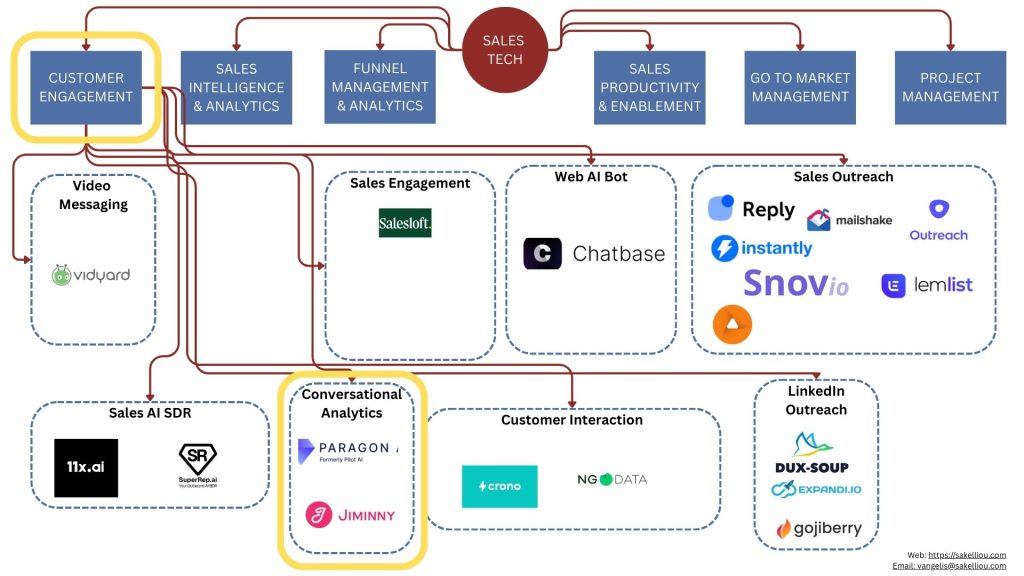
Understanding the Framework
This article is part of The State of the Growth Stack — a series that explores the tools shaping modern sales and marketing .
Each post breaks down one SalesTech category, its role inside the revenue engine, and the tools that define it.
After exploring Video Messaging, Sales AI SDR, and Sales Engagement, we now move deeper into the Customer Engagement pillar — into one of the most powerful yet underutilized categories:
Conversational Analytics.
From Activity Tracking to Conversation Intelligence
For years, sales performance was measured by surface metrics:
• Number of calls
• Emails sent
• Meetings booked
• Pipeline value
But none of these explain why deals move forward — or stall.
Conversational analytics changes that.
It records, transcribes, and analyzes sales conversations to uncover:
• Objections that appear repeatedly
• Winning talk tracks
• Buyer sentiment shifts
• Competitive mentions
• Risk signals inside live deals
Instead of guessing what works, teams now see it.
And what gets measured, improves.
3 Key Takeaways
Conversations Are Your Most Valuable Data Source
Every sales call contains insight into buyer intent, objections, and decision dynamics. Conversational analytics transforms unstructured dialogue into structured, actionable intelligence.
Coaching Becomes Evidence-Based
Managers no longer rely on anecdotal feedback. They coach using real call data — tone, pacing, question quality, objection handling — making improvement systematic rather than subjective.
Pipeline Risk Becomes Visible
Sentiment shifts, hesitation, competitor mentions, and reduced engagement are detected early. Revenue leaders gain clarity before deals are lost.
If you’re looking to grow your sales and build stronger client relationships, take a look at how I help teams like yours — and feel free to reach out for a chat.

All my books are on Amazon HERE
Why Conversational Analytics Tools Matter
Modern sales teams run dozens — sometimes hundreds — of calls every week.
Without analytics, those conversations disappear the moment they end.
This creates blind spots:
• Why are we losing to this competitor?
• Why are close rates inconsistent?
• Why do top reps outperform others?
• Why did this deal suddenly stall?
Conversational analytics platforms centralize:
• Call recordings
• Automatic transcriptions
• Keyword tracking
• Sentiment analysis
• Performance scoring
• Coaching insights
They turn conversations into structured data — and data into competitive advantage.
What Conversational Analytics Tools Actually Do
At a practical level, these platforms help teams:
• Automatically record and transcribe calls
• Detect keywords like pricing, competitors, or objections
• Measure talk-to-listen ratios
• Track sentiment and engagement
• Identify winning patterns from top performers
• Flag at-risk deals early
• Build searchable knowledge libraries from past conversations
They don’t replace human judgment.
They enhance it with evidence.
Tool Spotlight 1: Paragon
What It Is
Paragon blends conversational analytics with emotional intelligence training. It doesn’t just analyze what is said — it focuses on how it is said.
Why Teams Use It
• Deep conversation analysis
• Emotional intelligence coaching
• Behavioral performance insights
• Human-centered development tools
How to Use It Effectively
• Identify recurring objection patterns
• Coach reps on tone, pacing, and questioning
• Combine analytics with personal development
• Use insights in onboarding and performance reviews
Paragon is ideal for teams that want to elevate communication quality — not just activity metrics.
Tool Spotlight 2: Jiminny
What It Is
Jiminny is a conversation intelligence platform that records, transcribes, and analyzes sales calls while providing real-time coaching insights.
Why Teams Use It
• AI-powered call insights
• Live coaching during conversations
• Pipeline visibility
• Performance benchmarking
How to Use It Effectively
• Track competitor mentions across deals
• Monitor engagement drop-offs in late-stage calls
• Compare top performers with average reps
• Use real-time prompts for in-call guidance
Jiminny is particularly powerful for fast-scaling sales teams seeking structured coaching and forecasting clarity.
Practical Use Cases
Conversational analytics delivers immediate value when:
• Scaling SDR or AE teams – As teams grow, maintaining consistency becomes difficult; conversational analytics ensures best practices are replicated across every rep.
• Onboarding new reps faster – New hires can review top-performing calls and understand winning talk tracks, shortening ramp-up time significantly.
• Improving objection handling – By identifying recurring objections across deals, teams can refine scripts and proactively address concerns before they derail conversations.
• Identifying why deals stall – Sentiment shifts, hesitation, or missing stakeholder mentions can signal early risk long before the deal is officially marked as lost.
• Preparing for negotiations – Reviewing prior conversations provides context on pricing sensitivity, decision criteria, and internal power dynamics.
• Refining messaging based on real buyer language – Teams can extract the exact words buyers use to describe pain points and integrate them into marketing and sales messaging.
• Improving forecast accuracy – Instead of relying only on rep optimism, leaders can analyze conversation signals to assess deal health more objectively.
It bridges the gap between activity and outcome.
Ready to build your own growth stack?
Sign up below and I’ll send you the full Growth Stack Guide directly to your inbox.
My Take
In modern sales, execution is visible through engagement platforms.
But persuasion happens inside conversations.
Teams that ignore conversational data operate blind.
The best revenue organizations treat sales calls as strategic assets — not temporary interactions.
Conversational analytics turns intuition into insight.
And insight into performance.
Conclusion
Conversational analytics elevates Customer Engagement from activity management to conversation intelligence.
It connects dialogue, data, and coaching into one system — enabling sales teams to improve faster, forecast smarter, and win more consistently.
As the Growth Stack evolves, this category is becoming foundational for revenue leaders who want visibility beyond dashboards — and into the voice of the customer.
Frequently Asked Questions (FAQ)
1. What is conversational analytics in sales?
Conversational analytics is technology that records, transcribes, and analyzes sales calls to extract insights about buyer behavior, objections, sentiment, and deal risk. It turns conversations into measurable data.
2. How is conversational analytics different from call recording?
Call recording stores conversations. Conversational analytics analyzes them — identifying patterns, keywords, sentiment shifts, and coaching opportunities automatically.
3. Who should use conversational analytics tools?
Revenue leaders, sales managers, SDR teams, AEs, and enablement professionals benefit most — especially in scaling environments where coaching consistency and forecast visibility are critical.
If you’d like to receive more insights like this and be part of a small group I email from time to time, just sign up using this link.
In case you are looking to grow your business, I am here with you. Fill up THIS form and let’s talk.